Year: 2024
-
More Practical Strategies for GenAI in Education: Part 1

In January 2023, I wrote a post titled Practical Strategies for ChatGPT in Education. At the time, ChatGPT had just been released, and educators were grappling with its implications. The post outlined six strategies where ChatGPT could be used: planning, refreshing, improvising, personalising, collaborating, and communicating. It quickly became one of the most trafficked parts…
-
AI Metaphors We Live By: The Language of Artificial Intelligence

In “Metaphors We Live By,” Lakoff and Johnson emphasise that metaphors are fundamental to human thought and language, not just decorative language. In this post, I’ve examined my own use of metaphors to describe AI and analysed their implications, highlighting the power and limitations of these metaphors in shaping our understanding of AI and its…
-
Digital Plastic: Understanding AI-Generated Synthetic Media

What is Digital Plastic? Last year, I wrote an article introducing the concept of digital plastic, coining the term to describe AI-generated synthetic media, which, like its real-world counterpart, can be both helpful and harmful. Lately, I’ve been revisiting the term amidst ongoing discussions around quickly developing technologies like video generation. In this post, I’m…
-
The Dark Library: When Language Models aren’t Suited for Learning

Large Language Models like ChatGPT are praised as potential saviours or threats to education. While they promise personalised learning and assistance, their limitations are evident. Without a deep understanding or the ability to reflect independently, users must prompt them correctly, making them challenging as learning tools. Educators can leverage their capabilities but must understand their…
-
AI Policy Toolkit: Transparency Checklist

I have assisted numerous schools in Australia and abroad in developing their Generative AI Guidelines using national and international resources. The Australian Framework emphasizes transparency, outlining a practical checklist for schools to follow. By prioritizing open communication, ethical considerations, and ongoing evaluation, schools can align with best practices and ensure responsible AI implementation.
-
Why Writing Needs Good Friction

Technology companies aim to minimise “friction” in user experience, a concept also relevant in psychology and education. While some see friction as a valuable part of the writing process, others seek to reduce it. Diverse viewpoints from authors, educators, and AI experts generate a larger conversation about the implications of artificial intelligence and writing.
-
3 Levels of Lesson Planning with GenAI
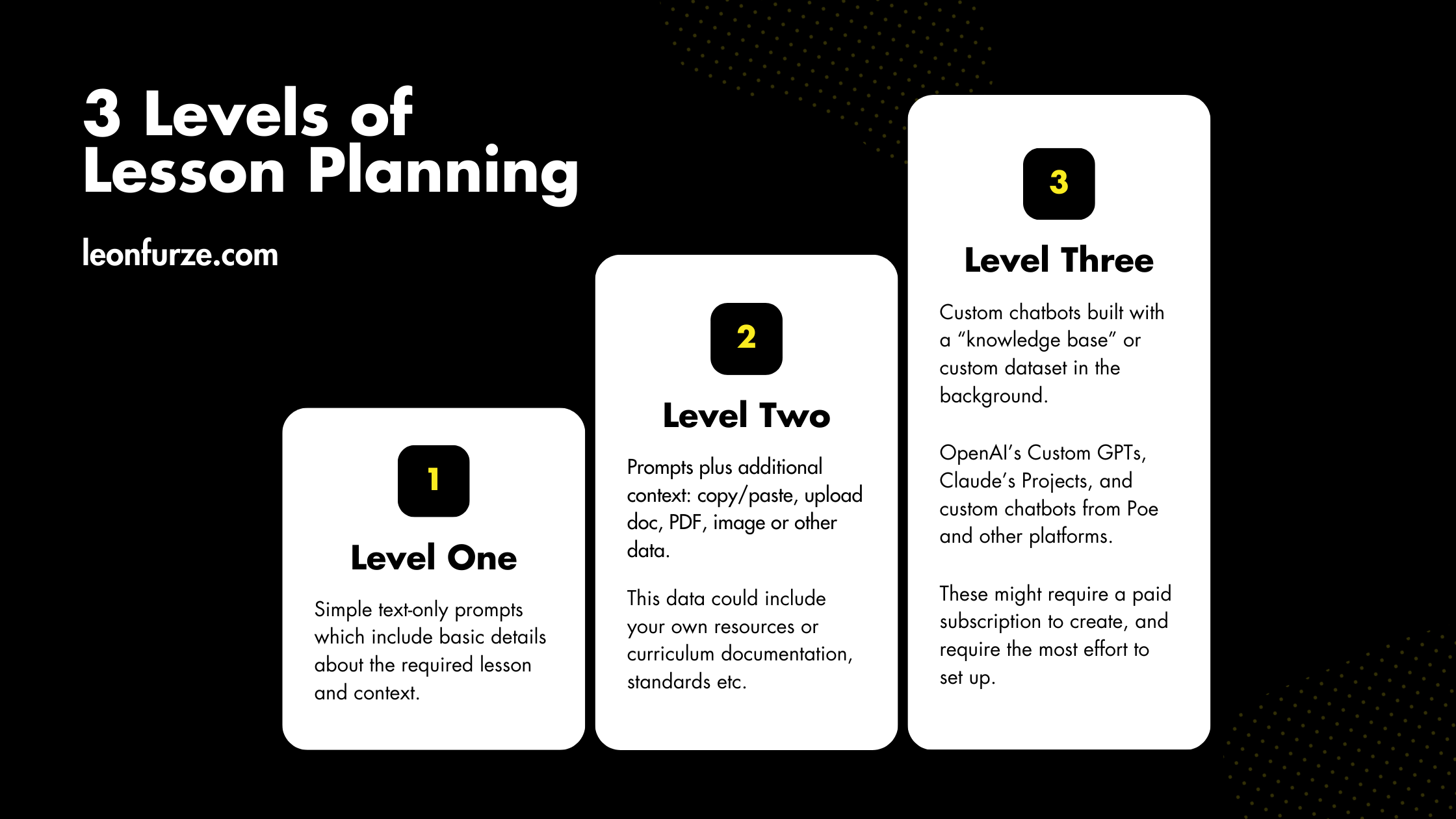
Generative AI, including ChatGPT, has impacted education. It now incorporates image recognition, text-to-speech, and code generation. Three levels for using GenAI in education are outlined in this post: Basic Prompts, Adding Context (including file uploads), and Custom Chatbots and Projects. The goal is to enhance, not replace, human expertise in teaching. Approach AI-generated content critically.
-
Hands on with Claude 3.5 Sonnet

Anthropic, a major AI developer and one of the biggest competitors to OpenAI, have just released a new model of Claude – their incredibly capable Generative AI application. It comes just a couple of months after the release of OpenAI’s GPT-4o, and after playing around with it for a few days I think it outstrips…
-
New Online Course: Introduction to Generative AI

This online course, “Introduction to Generative AI in Education,” equips educators with foundational knowledge of generative AI and its practical use in the classroom. Participants explore technical concepts, ethical considerations, practical applications, and global perspectives. The course focuses on integrating AI into educational settings, addressing bias, and understanding its impact on student wellbeing.
-
Multimodal Discourse and Generative AI

I’ve been re-reading Kress and Van Leeuwen’s 2001 book, Multimodal Discourse for the nth time, and, despite showing its age in some areas, it still offers some great language for discussing Generative AI. Kress and Van Leeuwen presented a new theory of multimodal semiotics, designed up update monomodal theories of communication with new technologies in…