Category: Pedagogy
-
Is This a Good Use of the Technology? Is It a Good Use of Your Brain?

The article discusses two crucial questions regarding AI: whether its use is appropriate and if it effectively engages one’s intellect. While these questions seem straightforward, their implications are nuanced and context-dependent, influencing how students and educators interact with AI technologies. Understanding these complexities aids in navigating AI’s evolving role in learning.
-
Exams Are Not the Answer: Part Two

This is part two of a pair of articles exploring the “exam reflex” facing schools and universities, and being driven by the news. In part one I looked at the AI cheating panic sucking up all the oxygen in mainstream media. I wrote about the “urgent threat” headlines, the Learning First report that is more nuanced than…
-
IYKYK Part 5: What Can AI Actually Do? Share Your Examples

This fifth post in the IYKYK series is a call to action. In order to “lift the ceiling” on teachers’ mental models of what AI can do, we need to share as many examples as possible. And not just the obvious examples, but the weird, awkward, slightly broken examples of people pushing and poking at…
-
IYKYK Part 4: From Knowing to Doing

So far in this series I’ve argued that GenAI has a discoverability problem, shared some examples that broke my own mental model, and explored how access and equity shape who gets to discover what. In this post I’ll talk about what happens after discovery, because knowing that a capability exists and being able to use…
-
Case Study: Saskatoon Public Schools and AI Assessment

The AI Assessment Scale (AIAS) has been successfully adapted by Saskatoon Public Schools to enhance conversations around AI in education. By reimagining its structure, the team shifted focus from binary use to a framework that supports different learning purposes, fostering transparency and student ownership of their learning process. Their approach sets a precedent for future…
-
Resistance Training Toolkit: Expertise
This is the first post in a series article articles introducing the Resistance Training Toolkit: evidence informed strategies for working with (and against) AI.
-
Gradually Reclaiming Responsibility

The article explores the concept of resistance in educational contexts, especially with the rise of GenAI technology. It examines how students must actively maintain ownership of their learning and critical thinking, especially as AI takes on more responsibility in the learning process. The traditional gradual release of responsibility model is adapted to consider AI’s impact,…
-
Resistance as a Framework for Combating Cognitive Offload
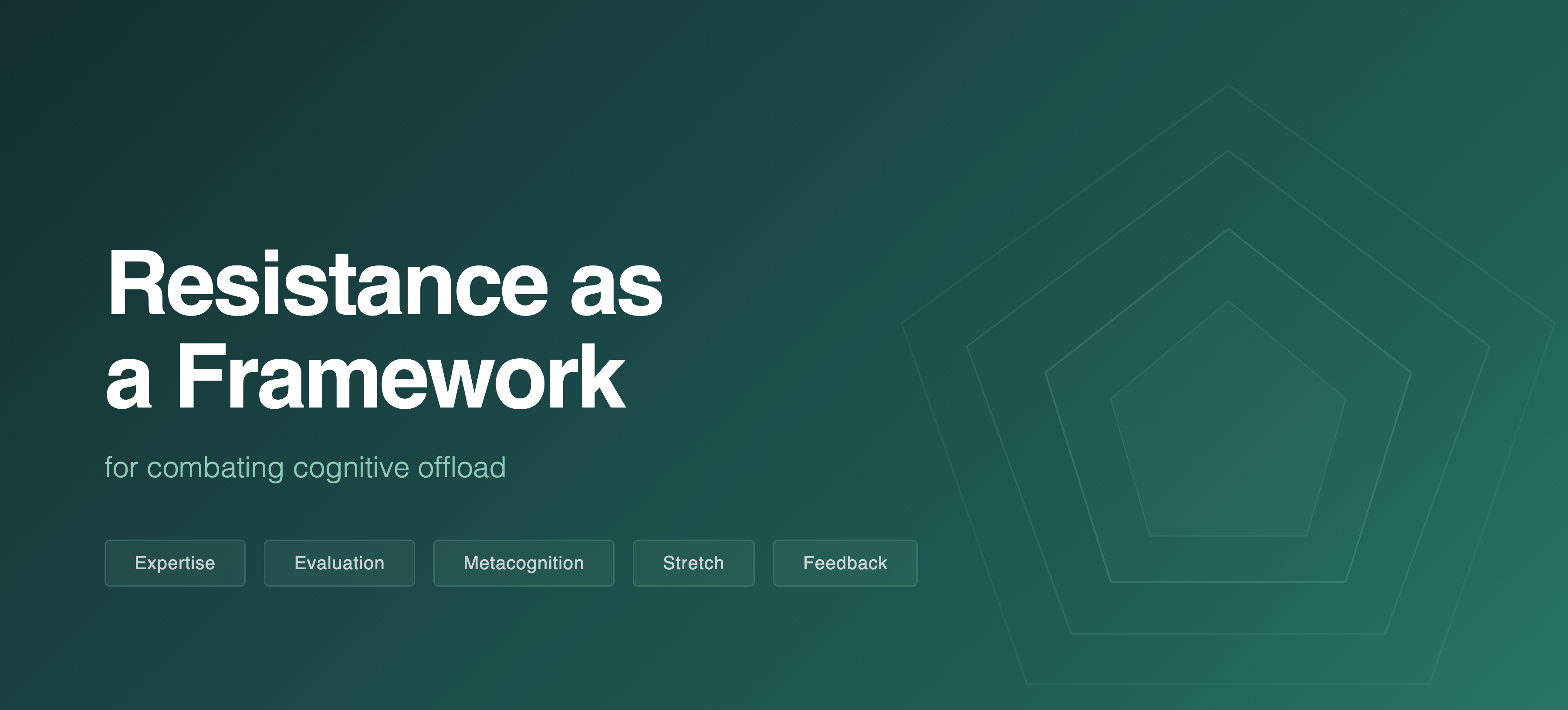
This post discusses the necessity of resistance in using AI for education, comparing it to physical training. While generative AI can lead to cognitive laziness, integrating resistance can help maintain learning integrity. Here’s a framework exploring expertise, evaluation, metacognition, cognitive stretch, and feedback to ensure beneficial AI usage.
-
What Happens to Expertise When Students Skip the Struggle?

When students use GenAI to skip the hard parts of learning, they miss the productive struggle that builds genuine expertise. This post explores why the “AI is just like a calculator” argument falls short, and why novices are most at risk of outsourcing the thinking that matters most.
-
Everything Educators Need to Know About GenAI in 2026
GenAI in education is a sprawling topic, so each January I try to distill it into a single post: what’s changed, what’s most important, and what you can actually do with the technology. This is 2026’s introduction to GenAI: I’ll dig deeper into each section throughout the year.