Category: Strategy & Governance
-
Is the Tide Turning Against AI in Australia?

On Sunday, the Sydney Morning Herald reported that NSW may restrict Year 12 students from unsupervised take-home assessments, following a letter from the Deputy Premier. Meanwhile, South Australia announced a royal commission into AI, highlighting diverging state approaches: NSW acts quickly for student protection, while SA seeks comprehensive understanding before regulation.
-
Cost versus Catchability in AI Use

The article explores AI-generated content, emphasising the risks associated with problem patterns, including “hallucinations” and context-specific costs. It introduces the concept of “catchability,” measuring the likelihood of errors being detected before they cause harm. The framework encourages examining expertise, review processes, and real-world implications of AI usage across various contexts.
-
Australia Just Set the Terms for AI

Earlier this week, the Prime Minister delivered a one-two punch on copyright and data centres: two of the most contentious national conversations on AI. Speaking at the University of Sydney, Anthony Albanese announced a set of national Australian standards for AI: a single framework covering copyright, data centres, energy, water, and the workforce, coordinated by…
-
Where does expertise live?

Explore the critical role of situated expertise in AI, its impact on trust, and how it influences the interpretation of expert knowledge.
-
Exams Are Not the Answer: Part Two

This is part two of a pair of articles exploring the “exam reflex” facing schools and universities, and being driven by the news. In part one I looked at the AI cheating panic sucking up all the oxygen in mainstream media. I wrote about the “urgent threat” headlines, the Learning First report that is more nuanced than…
-
Case Study: Saskatoon Public Schools and AI Assessment

The AI Assessment Scale (AIAS) has been successfully adapted by Saskatoon Public Schools to enhance conversations around AI in education. By reimagining its structure, the team shifted focus from binary use to a framework that supports different learning purposes, fostering transparency and student ownership of their learning process. Their approach sets a precedent for future…
-
Shadow AI: Bringing covert AI use out of the dark

Many schools face a widespread issue with shadow AI usage as staff and students employ unapproved tools. The updated VINE GenAI Guidelines aim to address this governance challenge by introducing a three-zone model for AI tool use. This approach encourages transparency and assessment rather than punishment, promoting safe AI integration in educational settings.
-
VINE GenAI Guidelines for Schools 2026
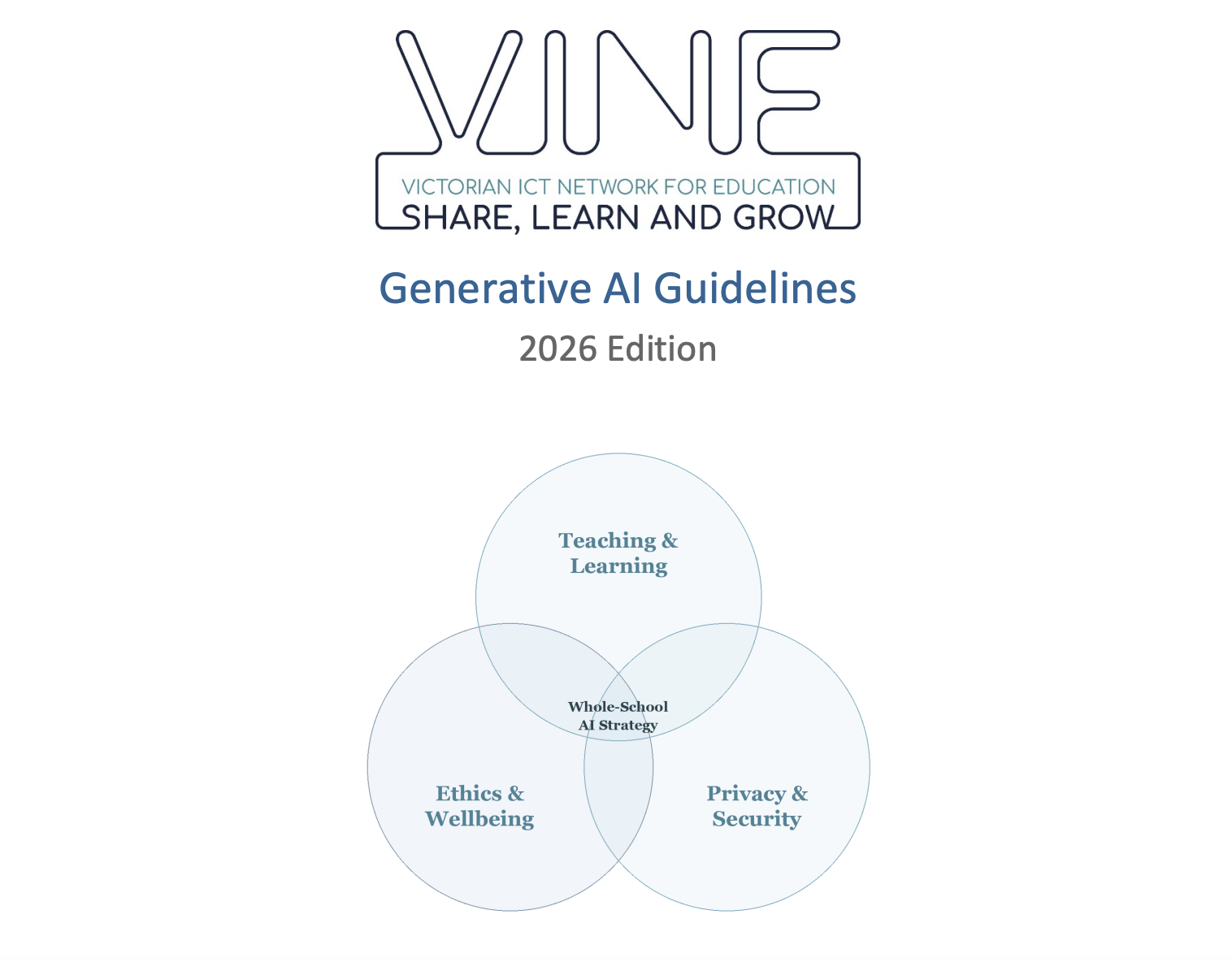
Explore the 2026 updates to VINE’s Generative AI guidelines, addressing AI’s evolving role in education and offering practical tools for schools.
-
IYKYK Part 3: Who Gets to Know?

The series discusses GenAI’s discoverability and access issues, highlighting how major platforms fragment capabilities through pricing tiers. Free users perceive limitations as a lack of utility, exacerbating an invisible gap between schools with varied resources. It urges for sandboxed solutions to explore advanced tools, rather than restrictive policies that hinder innovation.
-
A Taxonomy of Agentic AI

The evolution of AI agents, particularly since 2024, has shifted from marketing hype to practical applications across various levels of capability. AI agents, defined as large language model-based applications, perform semi-autonomous tasks using code. This taxonomy categorises AI agents from simple code-using chatbots to complex teams executing multi-faceted projects, highlighting their growing significance in educational…