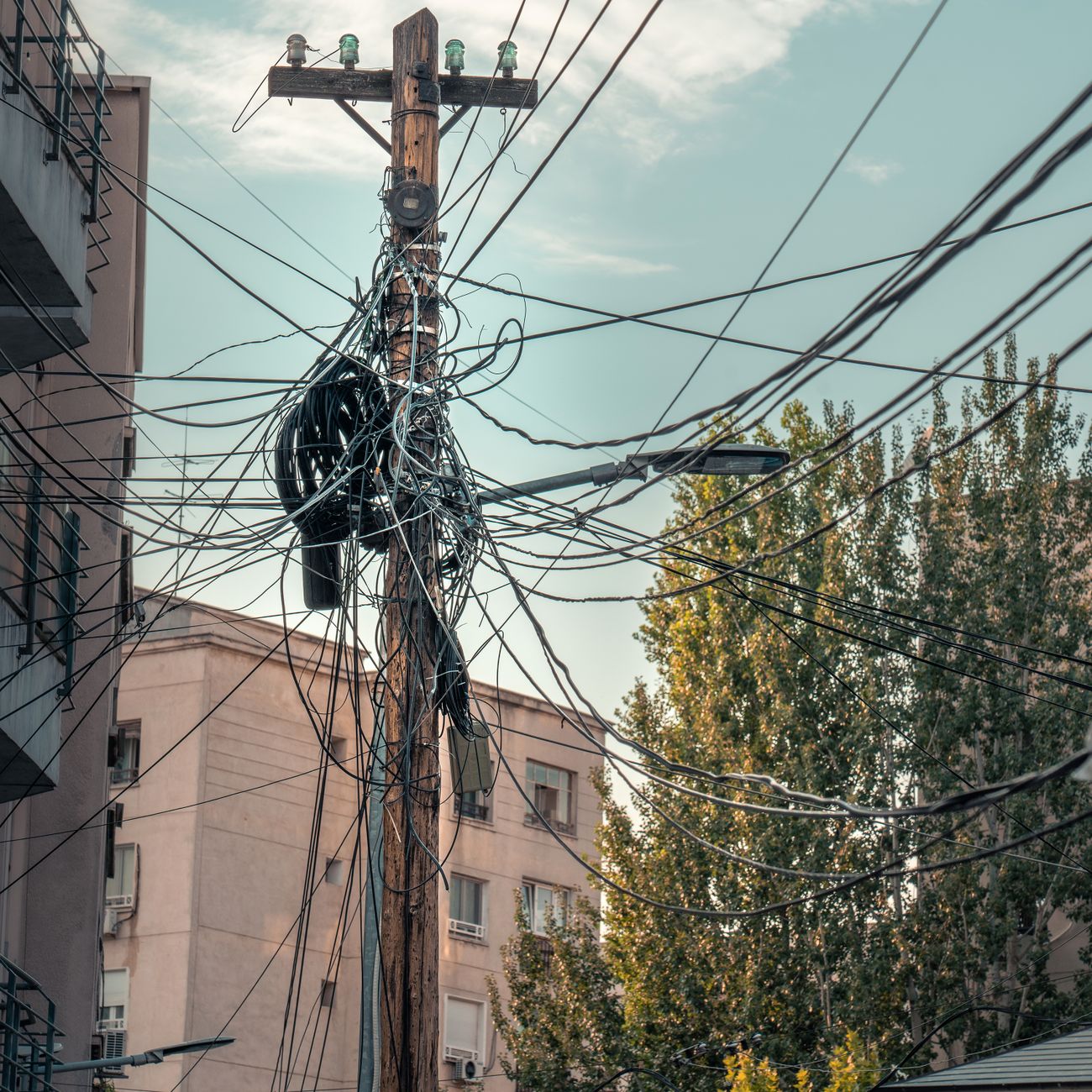
Large language model-based AI has almost reached the point where, for many applications, it just works. This is great for users, and even better for technology companies, but it creates a problem for technology critics. As the technology improves and is absorbed into the mainstream, it becomes harder and harder to focus the many limitations and drawbacks. And this isn’t the first time we’ve seen this happen.
When was the last time you criticised your phone lines? Not the provider, but the physical infrastructure needed to pick up a landline phone, dial a number, and connect to another person.
In 1996 an Australian Senate committee inquiring into the sale of telecommunications monopolist Telstra spent an entire chapter on the environmental impact of phone infrastructure, covering aerial cabling and mobile towers, demonstrations outside state parliaments, and a constitutional challenge in the High Court brought by nine councils. The committee recommended stripping the carriers of their exemption from local planning laws. That never happened, and nobody noticed, because by the time the argument reached its peak the network just worked.

Or how about the internet? We complain when it’s slow (which, here on the farm, is basically always) and we stop functioning entirely when our train goes through a tunnel. But in September 2025 when two cables were cut in the Red Sea and Microsoft spent days rerouting Azure traffic away from the Middle East, we didn’t hear many people saying, “you know, the geopolitics of undersea cabling has really made me rethink my relationship with the cloud”. We just noticed things felt a bit sluggish.
In the early days of any technology there is an ugly, fractious period where its inner workings are exposed to the general public. Electricity cables dangle ominously from ceilings, promising instant death to anyone foolish enough to switch from gas lanterns to electric lights. Telecommunications companies shred the landscape to pieces in a race to lay as much copper as possible before laws catch up with them. Data centres powered by unlicensed methane generators pollute the skies over poor neighbourhoods to train CSAM-generating chatbots.
And then, the technology recedes into the woodwork. The literal, physical cabling of electricity and phone lines merge into the structure of our homes and buildings, hidden away behind plasterboard and brick. Microsoft Copilot, formerly Bing Chat, formerly Clippy stops waving at users and adopts its rightful position as a disembodied floating rainbow ball. OpenAI stops pretending everything is “magic” and renames its flagship product the much more mundane “Work”.


The Agents are Coming
As we’ve seen from the history of other system technologies like electricity, phones, and the internet, this is not a new phenomenon. I wrote in 2023 about what might happen when AI disappears into the woodwork. Now, three years on, I think we’ve found the mechanism that is going to make it happen.
The term “AI Agent” reflects a confusing mismatch of technologies and is a word used differently by every company. A Copilot Agent is not much of an agent (it’s a custom chatbot). OpenAI Agents were briefly integrated into a browser called Atlas, which is now being shut down. Anthropic doesn’t have a product called “agent” but refers to them throughout their documentation, particularly in environments like Claude code.
I prefer Simon Willison’s simple definition: An LLM agent runs tools in a loop to achieve a goal. I’ve also written up a taxonomy of AI agents which runs from the simplistic chatbot-style capabilities of Copilot all the way through to the computer-using agent swarms of a capable coding tool like Claude code or OpenAI Codex.
Whichever way you define them, much like the early days of other technological infrastructure the wiring of agents is currently exposed, messy, and dangerous-looking.

That’s what an agent looks like right now: a terminal, a wall of scrolling matrix-like text, and a list of intimidating and obscure tool calls. It’s the software equivalent of a bundle of cables hanging from a telephone pole. It works, but it looks like it might electrocute you.
Design problems
And this is why I think we’re at the turning point. Last week Josh Miller, CEO of The Browser Company, rattled off a post on X while on holiday in Europe, wondering aloud why “nobody is really using AI agents”. It went viral, and WIRED’s Maxwell Zeff followed it up with an interview. Zeff backs up Miller’s claim with some numbers: OpenAI says Codex and ChatGPT Work have around ten million weekly users between them, with Anthropic’s Claude Code and Cowork are reportedly in the same range. ChatGPT and Gemini each have roughly a billion monthly users. Against the chatbots, agents are a rounding error.
Miller’s argument goes further than slow adoption. He thinks “AI agent” is an invented frame made up by the industry, and a way of describing a technology rather than a product anyone asked for. He thinks we should stop making people learn what an agent is, stop showing them the “harness” (one of my least favourite AI words, referring to the software infrastructure and scaffolding around an LLM), and just give them something that makes them feel calm and in flow when they open the laptop.
Miller supports his argument with The Browser Company’s most popular feature ever: Dia’s morning briefing, an AI agent-powered homepage that greets you with a to-do list assembled from your calendar and email plus a small piece of art. The user never needs to find out that there’s an agent hiding in the walls.

Of course, as Zeff points out in the WIRED article, “Miller’s arguments are convenient coming from someone who sells an AI-powered web browser.” Even so, I agree that much of the current ugliness of AI is a design flaw. For example, I think that the decision to make chatbots look like search engines – while useful for driving mass adoption – has severely limited our imagination about what AI is actually capable of.
Right now, though, I disagree with Miller: I don’t think we should have have the inner workings of AI agents plastered over in the name of convenience. I think we still benefit from seeing the ugly workings, the code, the clicks, the things which indicate what the LLM is actually getting up to under the hood of our devices. But I’m focused on critique, not convenience.
The problem Miller is lamenting in his X post is the thing currently holding the window of critique open for journalists, critics, and AI ethicists. And I feel it closing on my own end, because the more I use AI agents and the better they get, the less critical I feel.
I don’t mind shoving my hand into a tangled ball of code and watching as Claude Opus 5 does strange and potentially unsafe things with the innermost functions of my MacBook. It’s not for everyone, but watching Claude problem-solve complex requests, download its own open source toolbox, and work on a task for over an hour is undeniably impressive. Even so, I tire of staring at the Terminal window and wonder how long before AI just does stuff without needing to show its work.
I’m torn, basically. As a consumer, I want technology that just works. I want AI to seamlessly run in the background of my devices, connected across all my various accounts and silently orchestrating the more mundane tasks of my day-to-day work. I want AI to be all the things we’ve been promised over the last few years.
Devil’s bargain
Remember what happened with the phone companies in 1996: councils took a constitutional challenge to the High Court and they lost the argument anyway, not because the telcos fixed the problems, but because within a decade the network worked well enough that nobody could remember what the fuss had been about.
We have a responsibility in education to keep on being fussy about new technologies for as long as possible. Schools and universities should be trying to keep the workings visible, insisting that staff and students see how a thing was made and at what cost. For three years the main question in education has been “what can it do?” If the industry figures out what they’re doing with AI agents, that question will be answered for us, invisibly, by good product design. But it’s a devil’s bargain, trading critique for consumer-friendliness.
So, look at the wiring while it’s still stapled to the pole. Not because the ugliness is virtuous or even necessary, but because it is the last version of this technology that will ever explain itself to you.
Practical AI Strategies 2 is out September 9th from Amba Press. Join thousands of educators for the weekly newsletter and stay up to date with info from the blog and the upcoming book:
Leave a Reply