I’m sick of hearing that education is broken. I’m tired of technology vendors and CEOs who lack the experience of education beyond being at school themselves telling us that we need to “revolutionize the education system“.
More than anything, I’ve had enough of technological solutions which on the one hand claim to shift these broken paradigms, but in reality are only trying to accelerate it and make it more efficient.
The education system is a remarkably resilient system that does exactly what it was designed for. It’s not broken; it’s actually working perfectly. Unfortunately, many of the structures and processes within education that were suitable are now being challenged by societal, political, and economic shifts, which are outside the control of education.
Technologists love to share photos of Victorian-era schools with rows of forward-facing, dour-faced students and then compare those to photos of modern-day classrooms that have barely changed. Whilst it’s true that some aspects of education appear starkly outdated, it’s facile to suggest the entire industry and purpose of education as a system is broken.

In the past 18 months, I’ve worked with literally hundreds of schools across Australia and worldwide. When I visit face-to-face, I often get an opportunity to walk around the school, and I’ve rarely come across those front-facing, individual seating classrooms with students scratching away at worksheets. That’s not to say these schools don’t exist, but it certainly doesn’t represent the entire institution.
What I actually see are teachers who are trying to work out the implications of new technologies, shifting societal and cultural norms, and a generation of young people who are more connected than ever before yet lonelier and more anxious. I see educators who are trained in subject disciplines now faced with technologies which are being promoted as branded, regurgitated content tutors, presented by edtech companies as “teacher’s assistants” with promises that “we are not trying to replace you, honest” – belied by the cynical and often contemptuous tone with which these companies approach education.
There are certainly systemic issues in education which mean that a lot of things once deemed appropriate are no longer likely to be successful, but let’s be clear: technology isn’t going to revolutionise any of them.

Adding sparkle
Microsoft recently released an update to Teams for Education. At first, I was slightly disappointed, then I got angry, and then when I really thought about it, I realised that Microsoft’s latest efforts were indicative of approaches to education from the technology sector that have plagued us for a long time. In fact, the part that really got me about this Microsoft video was not the low-stakes use of powerful generative AI technology to add detail to an assessment or the other features – it was the “add sparkle” button.

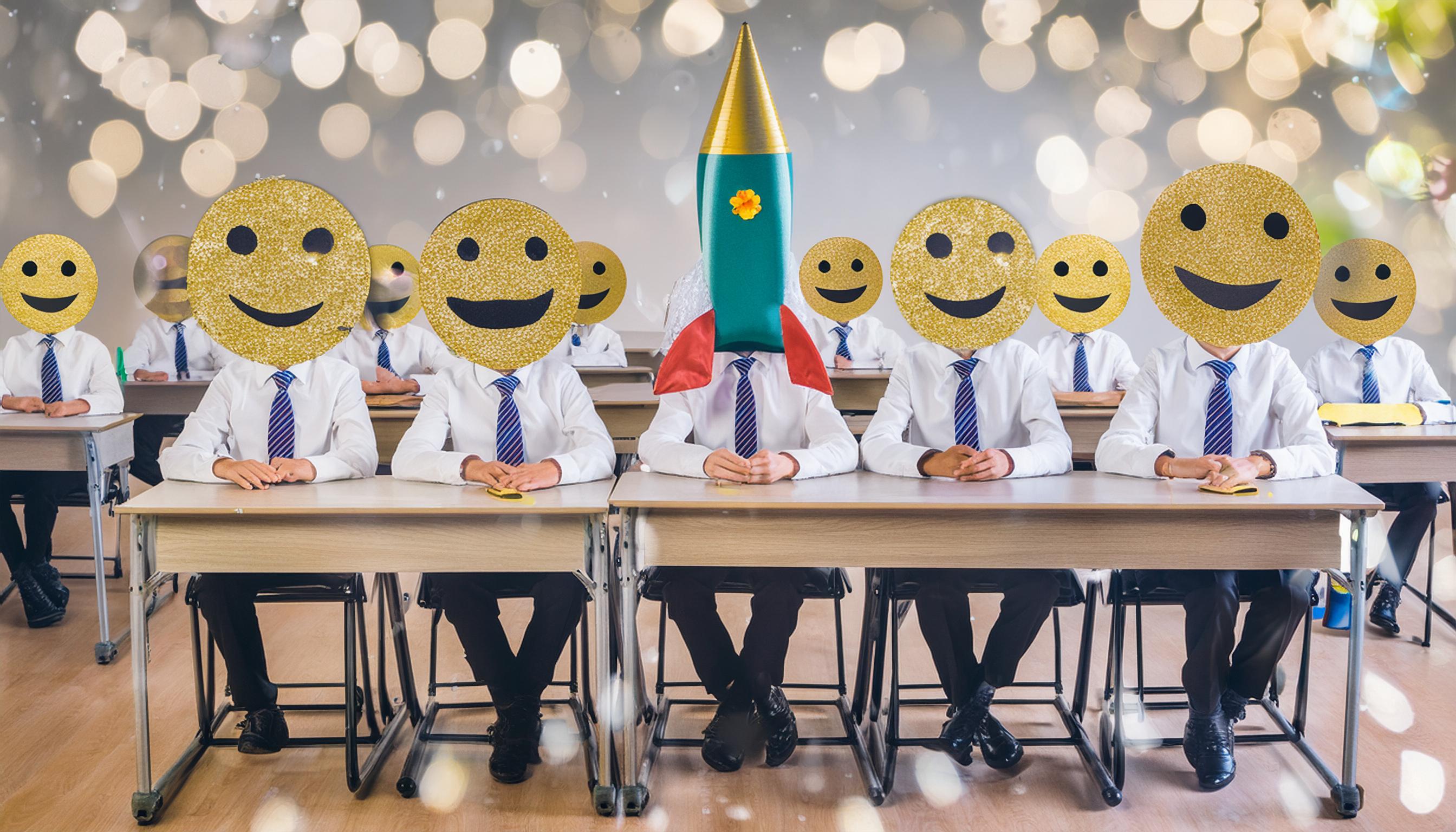
I would love to have been a fly on the wall of whatever focus group came up with the idea of a button which adds emojis to assignments. I would love to have been part of the discussions that led to a team of developers at Microsoft creating a button which literally just adds emojis to teachers’ work. It’s infantilising, condescending, and honestly, the angrier I get about it, the more I convince myself that it shows actual contempt for educators.
The “sparkle” button is a symbol for the way that technology vendors view educators:
Overwhelmed with administrative burdens? Here’s a button that can do all of your lesson planning for you.
Stressed out by constant behavioural issues and a revolving door of stressed students stuck in a loop of high-stakes testing? Try a mindfulness app and breathe for five seconds. Maybe look at a sunrise or two.
Feeling anxious about technology replacing fundamental parts of your job? Add sparkle. Cover everything with cheerful emojis.
The real problem with the “sparkle” button is that it shows not only contempt for educators but a complete lack of understanding about what education is. Education is not a set of proformas that needs to be completed – lesson objectives to be checked off, assignments to be handed out.
It’s not the automatic grading of student work, facile chatbot “tutors” for students to have endless back-and-forth conversations with until they somehow magically “get it.” It’s not surveillance technologies that allow parents and teachers to spy on young people on the off chance they use a “dangerous” word. It’s not a “homework helper” that prepares students for standardised testing or high-stakes examinations. All of these tools exist; none of them are what educators or students need. They all just “add sparkle” – and they are about as useful as a button that covers an assignment sheet in emojis.
The great irony is that these companies are louder than anyone when it comes to proclaiming that the education system is broken and needs to be revolutionised. And yet, they seem to be working harder than the education sector itself at entrenching some of the worst parts of education.
Tick-a-box chatbots, trained on a standardised curriculum, and limited to “safe” interactions to guide students down predetermined paths of learning – it’s just artificial intelligence layered over the top of the same old, same old. Students interacting one-to-one with a chatbot might as well be sitting in rows scratching away at their photocopied worksheets. The promise of technology to accelerate collaboration is really just an excuse for scaling up the forward-facing classroom. We can even have remote or hybrid rows of individual students, with some students just happening to be sitting in their bedrooms at home as they stare blankly at their screens.
Generative AI platforms tied into these standardised curricula will no doubt be of great use to students competing for high-stakes examination scores. Students with access to the best chatbots will, of course, get the best results – just like students in past years who have had access to the best teachers and tutors have gamed the system.
The teacher’s lesson planning, the creation of resources, and the preparation of individual learning plans for students will become a thing of the past, along with the autonomy and creativity that many educators cherish. Teachers won’t need as much planning time or time to collaborate because they’ll all have access to generative artificial intelligence that can do all the work for them. So we can scale up class sizes because we’ve reduced the administrative burden. Grading software reduces the need for teachers to adapt or interact with student work. But hey, at least we can cover that work in emojis.

Another Way
We could reject this model and everything it suggests. We could reject the idea that education is broken, and instead look at the ways that education has already changed for the better in recent decades, becoming more inclusive, more cognisant of historical biases, and more adaptable. We could celebrate the work of educators who have done the difficult job of pushing back against systemic barriers that emerge from standardisation and high-stakes testing and still managed to provide students with a rounded, engaging, enjoyable school experience.
Importantly, we can support educators who feel unable to see a way through these problems – not by providing technological solutions, but by creating the space and time for quality professional learning and collaboration.
And we can explore ways that educators can use technology to create better tools for themselves and their students – tools which don’t attempt to automate away the good parts of the job, but which extend the educator’s capabilities, which are reliant on the educator’s expertise in subject knowledge and pedagogy.
Technology will not revolutionise education. Artificial intelligence will not revolutionise education. But education will continue to evolve because of the passion, commitment, professionalism, flexibility, and enthusiasm of educators – the people in the room with the students.
The Practical AI Strategies online course is available now! Over 4 hours of content split into 10-20 minute lessons, covering 6 key areas of Generative AI. You’ll learn how GenAI works, how to prompt text, image, and other models, and the ethical implications of this complex technology. You will also learn how to adapt education and assessment practices to deal with GenAI. This course has been designed for K-12 and Higher Education, and is available now.
Get in touch to discuss how Generative AI can be brought into your school or university in ways which respect educator autonomy, and foreground the ethical concerns of technology. Sparkle not included.


Leave a Reply