This post is part of a series exploring the term ‘digital plastic’, which I coined in 2023 to describe the positive and negative impact of GenAI on the digital ecosystem. You can read the original article here and the 2024 post here.
Is generative AI going to do more harm to the digital ecosystem than good? Although it’s only been a couple of years since the release of ChatGPT, it certainly feels like there has been a qualitative shift online in the volume of AI generated content.
You can’t doom scroll social media or thumb through YouTube without hitting some sort of – often weirdly terrifying – AI content: at least, I can’t, which maybe speaks to my algorithms more than social media more broadly. And the quality of GenAI has now reached a point where it is not possible to detect real from fake with the naked eye. Try it for yourself and find out.
Real or Fake? The AI Deepfake Game
If you’re interested in AI images, audio, and video, make sure to grab the free 20+ page resource How to Spot a Deepfake by signing up here:

Only Concepts of Colour
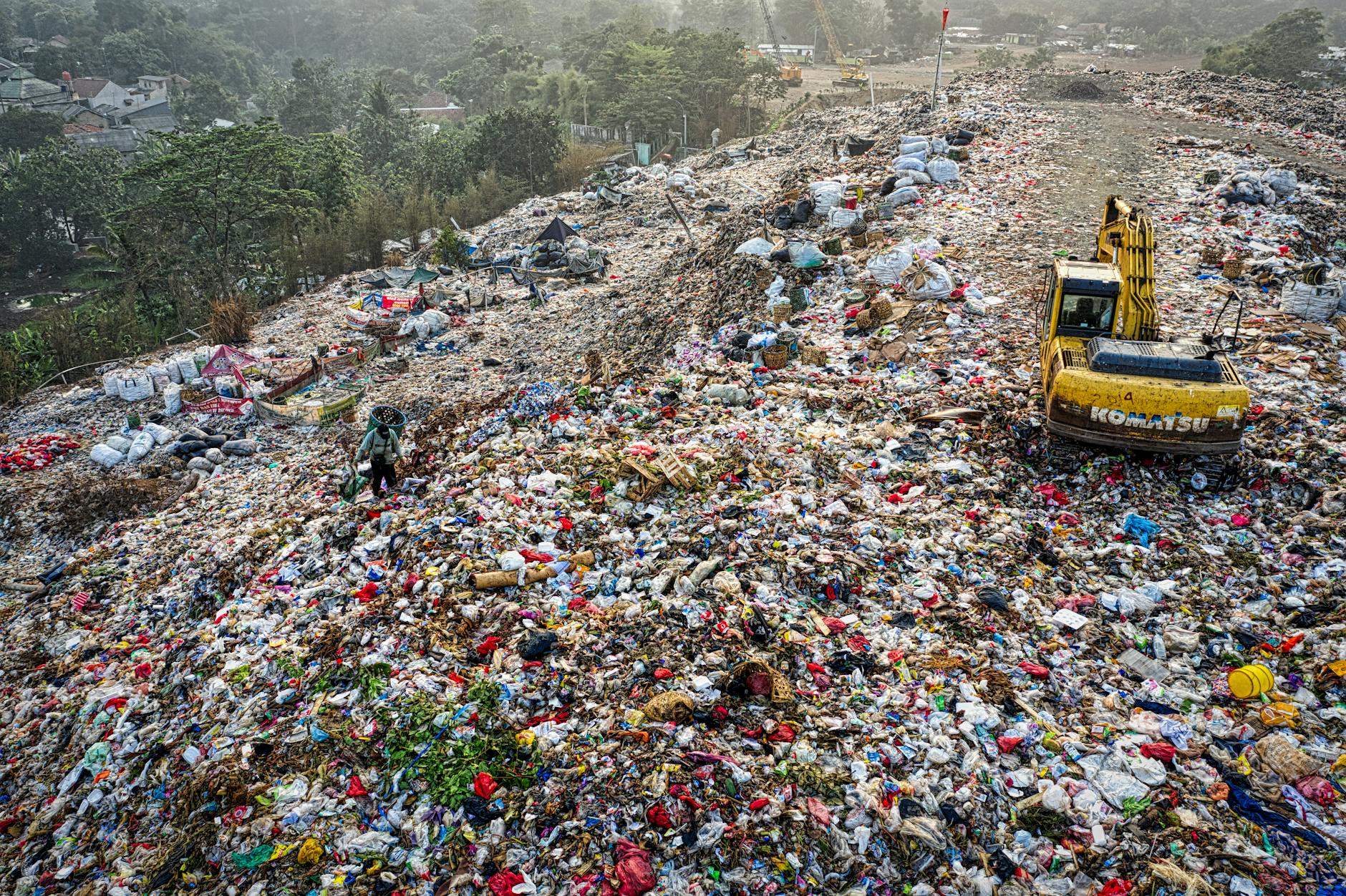
To describe this phenomenon – the flooding of the internet with synthetic media – I use the phrase “digital plastic“. Like its physical counterpart, digital plastic is flexible, ubiquitous, helpful, harmful, and quickly filling our online ecosystem with floating trash.
In Gunther Kress and Theo Van Leeuwen’s 2001 book Multimodal Discourse, the authors dedicated a sub-chapter to exploring plastic as a mode of communication, and I have extended that towards this new synthetic medium. Multimodal Discourse includes a fly through of early twentieth century reactions to plastic, and I think it’s worth repeating some of that commentary to help understand these new digital plastics.
Roland Barthes was in two minds [about plastic]. On the one hand he called plastic a ‘miraculous substance’ and ‘a spectacle to be deciphered’ which ‘hardly exists as a substance’, on the other hand he called it ‘graceless’, and ‘destroying all the pleasure, the sweetness, the humanity of touch’, while its colours were ‘mere names’, ‘able to display only concepts of colour.’
Kress and Van Leeuwen (2001, p. 80) quoting Barthes (1972, p.54-5 and 97-8)
Those conflicted comments are similar to contemporary discourse around generative AI, for example the effusive and “miraculous” qualities of GenAI espoused by Bill Gates:
“The development of AI is as fundamental as the creation of the microprocessor, the personal computer, the Internet, and the mobile phone … it will change the way people work, learn, travel, get health care, and communicate.”
Versus Bender et al.’s description of language models as:
“haphazardly stitching together sequences of linguistic forms … according to probabilistic information about how they combine, but without any reference to meaning.”
On the Dangers of Stochastic Parrots: Can Language Models Be Too Big?

A Level of Abstraction
In a slightly more obtuse quote (which is understandable, given the author…) Kress and van Leeuwen also include this gem about plastics from French philosopher Jean Baudrillard:
“The manufacture of synthetics signifies for materials a stepping back from their natural symbolism towards a polymorphism, towards a superior level of abstraction which enables a game of the universal associations to take place.”
Again, we can find mirrors of this in contemporary discussions of GenAI. Various authors and researchers have detailed the level of abstraction that modern AI systems operate at, both in terms of the volume of data they are trained on and how they represent that data:
“We’re reaching an event horizon of datasets where they’ve become so massive, they are like enormous gravitational objects that absorb all light and all investigative possibilities.”
Kate Crawford et al., 2023 A Perspective on AI and Data in Design: Interview With Kate Crawford.
“Think of ChatGPT as a blurry jpeg of all the text on the Web. It retains much of the information on the Web, in the same way that a jpeg retains much of the information of a higher-resolution image, but, if you’re looking for an exact sequence of bits, you won’t find it; all you will ever get is an approximation.”
“There is only a giant ocean of jello — a vast mathematical mixing.“
Digital Plastic
Generative AI already saturates our screens much as petro-plastics saturate the physical world: cheap to produce, infinitely re-combinable, and stubbornly persistent. Like plastic, it invites both wonder and dread. Its champions, echoing Bill Gates, celebrate a “miraculous” agent of progress, while its critics, in the spirit of Bender’s “stochastic parrots,” or Lanier’s “jello” warn that AI’s gloss of coherence masks its hollow form.
Both impulses are true, but taken individually both miss the larger point Baudrillard foresaw: once matter – or meaning – can be melted down and extruded at will, the “game of universal associations” accelerates. Content ceases to point beyond itself; it becomes self-referential flotsam swirling in an endless gyre.
If the twenty-first century’s first ecological crisis was plastic filling the oceans, its second might be the slow suffocation of our information oceans by synthetic text and image: content whose provenance, intent and truthfulness are opaque to human readers and opaque even to the machines that generated it. Whether that prospect becomes an existential threat or a manageable nuisance depends on the critical literacies we cultivate now. Multiliteracies, as a starting point, could remind us that every mode, every platform, every algorithm is a designed social act.
Our task, then, is not to detect the fakes (a battle we are already losing) but to teach students – and ourselves – to interrogate the design of AI systems: Who benefits from this output? Whose voices are missing from the training data? What alternative assemblages could better serve human flourishing? And what do we both gain and lose through our interactions with digital plastic?
Subscribe to the mailing list for updates, resources, and offers
As internet search gets consumed by AI, it’s more important than ever for audiences to directly subscribe to authors. Mailing list subscribers get a weekly digest of the articles and resources on this blog, plus early access and discounts to online courses and materials. Unsubscribe any time.
Want to learn more about GenAI professional development and advisory services, or just have questions or comments? Get in touch:


Leave a Reply