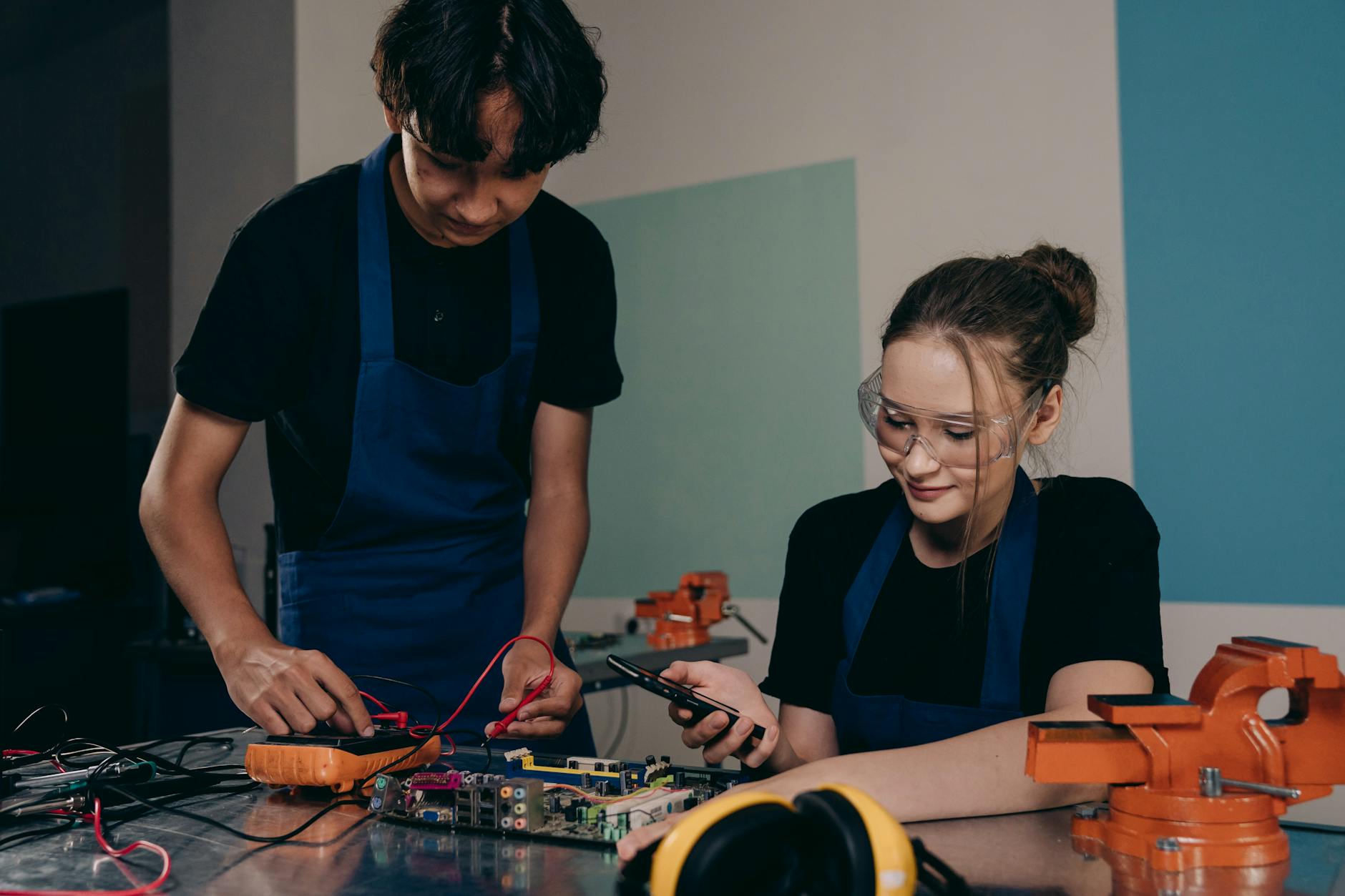
A couple of weeks ago, I spent the day in Canberra at the Future Skills Organisation National Forum, which focused on artificial intelligence in the Vocational Education and Training (VET) sector in Australia. I’ve worked in the VET sector myself, teaching Certificate II and III Music Industry towards the end of my classroom career, and for the past four years, I’ve supported many VET providers, RTOs and TAFEs in understanding artificial intelligence.
It was great to attend the forum and see the beginnings of a sector-wide initiative to help VET teachers prepare for the implications of artificial intelligence across the many diverse industries and organisations represented by the 5 million students per year in vocational education.

Why Vocational Education Benefits from GenAI
The vocational education sector is incredibly diverse, covering everything from trades like building and construction, electrical, plumbing and automotive through to allied health, childcare, education, the creative arts and the technology industry. In Canberra, we heard from people representing every corner of the industry, including education, retail, tourism, finance and digital technologies. Every one of these industries is being impacted by the current AI boom.
There were some frustrations in the room, because, notoriously, it is difficult and slow to update VET training packages. Commissioner Cameron Baker talked about the seven-step process of approval and the fact that not all states have the authority to pilot and approve their own programmes under the current federated model. Minister for Jobs and Skills, Andrew Giles, also spoke about the perceived slow-moving nature of the sector.
But despite those frustrations, there was a refrain throughout the day that it is possible to move quickly within certain parts of the sector. Future Skills Organisation CEO, Patrick Kidd, summed this up at the end of the day by pointing out that the tempo of different parts of the VET sector can and should be different. We don’t need to rush regulation and risk, but we do need to move more quickly in updating the kinds of courses and skills on offer to students. As an example, Natalie Turmine, CEO of Service and Creative Skills Australia (SaCSA) suggested ways to break down training packages, thinking of them as a lattice rather than a ladder, so that students have more flexibility in choosing how they get from the start to the end of their qualifications.

lattice” rather than a ladder. Image source: Future Skills Organisation
A theme of the day was that whilst the vocational education sector is seen as a slow-moving beast with its own peculiar red tape, it is still possible to respond to emerging technologies like artificial intelligence, and there’s an imperative to do so.
Roughly two thirds of people in Australia work in a small to medium enterprise, and many of those like myself are small business owners. I’ve personally found GenAI incredibly useful in managing my own business. Anyone who’s been on this blog for a while will know that I don’t subscribe to AI hype about it “revolutionising education” or ChatGPT-5 suddenly becoming conscious and developing sentience. But it is undoubtedly a useful administrative tool.
I use it all the time for various parts of my business, from marketing to web development. I use it often as a de facto IT support person. Although I’m pretty handy with the computer, most of my business is conducted and managed digitally, and I often need extra support. Nine times out of 10, I turn first to GenAI for that kind of support.
But as was pointed out throughout the day, small business owners like me notoriously don’t have any extra time. We do the administration of our businesses in the evenings and on weekends. We burn ourselves out, working from six o’clock in the morning to 10 o’clock at night, carrying out the roles of half a dozen people by ourselves, and I have found GenAI genuinely useful for filling the gap on some of those roles. How does a small business owner or an employee or a tradesperson find the extra hours in the day to learn about AI? I only get away with it because it is my full-time job.
The Role of Vocational Education Providers in AI Education
This is where VET teachers could play an important role. Millions of learners pass through the doors of schools, TAFEs and higher education institutions to complete certificate and diploma level courses across the different states and territories. Some trades require qualifications through VET. So there are many opportunities to include discussions of artificial intelligence, but all of this is hypothetical if the trainers themselves don’t understand the technology.
For the past couple of years, I have been running sessions for organisations like the VET Development Centre in Melbourne and Chisholm Institute, looking at how artificial intelligence can play a role, both in their own day-to-day administration, curriculum design and as part of the assessment process for students.

Having taught VET myself, I know that assessment practices in vocational education can be perceived as quite rigid, but I honestly think that there’s more flexibility in VET than in both K-12 and higher education. While VCE and HSC students are conducting many of their assessments as high stakes, single point in time, examination-style assessments (even though they probably shouldn’t be), and universities are conducting the majority of their assessments as some form of written outcome, there’s a huge breadth of valid assessment tools available to a VET teacher: observation, simulations, role plays, Q&A, practical assessments are much more common in VET because the skills being assessed are much more grounded in reality, and these types of assessments are much less vulnerable to interference from artificial intelligence.
While a student could easily use ChatGPT to knock over an essay, it’s pretty difficult for ChatGPT to put up a drywall, fix a faulty circuit, administer an IV or support a special needs child in the classroom. From my perspective, VET is the perfect place to introduce meaningful conversations about artificial intelligence helping rather than getting in the way of student learning.
All vocational courses have minimum requirements for literacy and numeracy, and it’s, of course, important to ensure people in any industry are qualifying with these minimum levels of fluency, but this causes frustration, because a typical VET teacher doesn’t necessarily have the means or the time to help improve a student’s literacy, and artificial intelligence could potentially help in that area. A large number of vocational education students have English as a second language, and generative artificial intelligence is proficient at translation.


Beyond the Classroom
Finally, it’s important to remember that vocational qualifications are not the end point. A learner gets a vocational qualification to demonstrate that they can do something so that they can then go out and do it. Coming back to GenAI for small business owners, a qualified plumber running their own business, either as a solo operator or as manager of a team, probably doesn’t have many opportunities to keep up to date with the rapid developments of digital technologies. They’re far too busy doing their job.
So vocational education and training can be an initial space to develop some skills and understanding of the technology in a way which can be beneficial for managing that day-to-day job. This could involve the use of GenAI to support with the many, often complex bits of paperwork involved in running a business in Australia. Artificial intelligence is already being built into platforms like Xero and MYOB, commonly used by small business operators, and it pays to understand these technologies to get the most out of them, and also to know how not to use them.
The Future of Generative Artificial Intelligence and Vocational Education
A lot of the conversations about AI are predicated on this idea that the technology is inevitable. I’ve written before about why I don’t think it’s true, but I do think the technology is already ubiquitous. Future Skills Organisation has launched an AI accelerator in partnership with many industry associations, TAFEs, RTOs and technology companies like Microsoft and Adobe in order to pilot and explore the opportunities of this ubiquitous technology in the sector.
It’s important that we recognise we do not know what this technology looks like in five years’ time, but we can make a few solid bets. It will be increasingly multimodal. The technology will continue to develop away from text-to-text chatbots like ChatGPT and towards speech-to-speech, video and audio combinations. This means that learners and people entering the workforce will increasingly encounter AI avatars in areas such as health and finance, for example. This also has huge implications for training providers, who will find it increasingly easy to use the technologies to create content, opening up the possibility of increased access, but also the risk of decreased quality.
AI agents are still mostly hype, but this is such a high area of investment that it’s possible to imagine that in the next five years or so that the technology will mature. That could mean that a small business operator like myself would have the capacity to offload even more administrative and management tasks to artificial intelligence, freeing up hours in my day to do my actual job.
I’m optimistic that of all of the sectors of education – K-12, higher education, vocational education and adult training – that the VET sector is the one best placed to make the best use of artificial intelligence technologies. I agree that whilst the sector sometimes seems slow-moving, there is huge potential to move quickly within the existing structures.
We need to ensure that teachers in the sector have access to quality, consistent materials that improve their own understanding and use of generative artificial intelligence and how they talk about these technologies with their learners across the industries. We need to ensure that small to medium enterprises have access to on-demand resources to help them to understand the potential benefits of generative artificial intelligence. We need to look beyond the hype and supposition and share examples of how real businesses, including businesses like mine, are actually using generative artificial intelligence for the little day-to-day time.
Want to learn more about GenAI professional development and advisory services, or just have questions or comments? Get in touch:
Your message has been sent


Leave a Reply